In the world of rotational molding, Polyethylene (PE) is the comfortable standard. It is forgiving, chemically resistant, and dominates the vast majority of applications. But for product designers and engineers, “standard” often is not enough. There comes a point in high-performance applications where the material limitations of PE become clear. This is especially true when you need optical transparency or the ability to withstand elevated operating temperatures.
This is where polycarbonate rotational molding enters the conversation.
Polycarbonate (PC) has long been recyclable and widely respected for its strength and clarity, but it is notoriously challenging to process in rotational molding. Still, it offers a suite of physical properties that standard thermoplastics cannot match. By understanding and controlling this complex polymer, we help bridge the gap between heavy, fragile glass and lightweight, durable plastic.
The Science: Why Polycarbonate Is Different
To understand why polycarbonate performs differently than polyethylene, you have to look at the molecular level.
Polyethylene is a semi-crystalline polymer. Its molecular chains fold into organized crystal structures as they cool. While this makes the material tough and chemically resistant, those crystals scatter light. The result is a hazy or milky appearance, even when clarified.
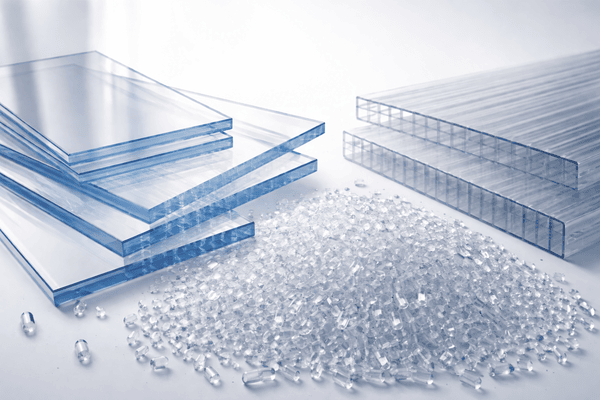
Polycarbonate, by contrast, is an amorphous polymer. Its molecular structure contains bulky carbonate groups that prevent crystallization. Because the molecules do not organize into crystals, light passes through with minimal distortion. This structural difference is what enables true, glass-like transparency in rotational molding.
In an industry that has shifted heavily toward highly whitened materials, demand is growing again for translucency and visual access inside parts. Polycarbonate remains one of the few materials capable of delivering that performance reliably.
Three Critical Advantages of PC
Moving to polycarbonate is not just about aesthetics. It is a functional upgrade for demanding environments.
1. High Optical Clarity
For applications like lighting globes, protective covers, or visual inspection windows, clarity matters. While clarified PE can offer partial translucency, polycarbonate delivers far greater transparency. It enables shatter-resistant components that replicate the look of glass without the weight or fragility.
2. Superior Stiffness and Structural Integrity
Polyethylene is known for ductility, meaning it flexes before it breaks. Polycarbonate offers significantly higher stiffness and hardness. It produces rigid parts that retain dimensional stability under load, making it well suited for protective housings and structural enclosures that cannot afford excessive flex.
3. Heat and Flame Resistance
Polycarbonate offers strong thermal stability compared to standard PE. It maintains structural integrity at higher temperatures and exhibits inherent flame-retardant behavior in many formulations. This makes it a strong candidate for electrical housings, components exposed to internal heat sources, or industrial applications requiring elevated temperature resistance.
Talk to an Engineer About Polycarbonate Rotational Molding
Talk to an Engineer About Polycarbonate Rotational Molding
If your project demands more than standard materials, reach out through our contact page. We’ll help you determine if polycarbonate rotational molding is the right solution.
If your project demands more than standard materials, reach out through our contact page. We’ll help you determine if polycarbonate rotational molding is the right solution.
The Manufacturing Challenge: Why It Requires Precision
If polycarbonate offers these advantages, why is it not more common in rotational molding? The answer lies in processing sensitivity.
Polycarbonate requires tighter control than polyethylene. The processing window is narrower, and small variations can affect clarity and performance.
Moisture Sensitivity
Polycarbonate is hygroscopic, meaning it absorbs moisture from the air. If resin is not properly dried, moisture turns to steam during the heating cycle, leading to splay, internal weakness, or visual defects. Strict drying and handling protocols are essential before the material ever enters the mold.
Controlling Clarity
In standard rotational molding, minor internal voids are often hidden within the wall structure. In a clear polycarbonate part, even a small bubble can be visible. Achieving high optical quality requires:
Precise Temperature Control
Internal Air Temperature must be closely monitored. Too cool and the material will not fully flow; too hot and it can degrade or discolor.
Pressure Management
Positive pressure inside the mold can help minimize void formation and improve wall integrity, contributing to clearer finished parts.
Design Considerations for Polycarbonate
Switching to polycarbonate also impacts tool design. Because PC is amorphous, it exhibits lower shrinkage compared to crystalline polyethylene.
Lower shrinkage allows for strong dimensional accuracy. However, it also means the part does not naturally pull away from the mold during cooling. Proper draft angles, release strategies, and thoughtful geometry are critical for consistent demolding.
Our engineering team works collaboratively during the design phase to optimize draft angles, wall thickness transitions, and corner radii. The goal is not just moldability, but repeatable, production-ready performance.
The Integrity Advantage
At Integrity Rotational Molding, we focus on engineering practical solutions, not just running material through equipment.
Whether the need is transparency, elevated heat resistance, structural rigidity, or a material that performs where standard polyethylene cannot, we evaluate whether polycarbonate rotational molding is the right fit for the application.
If your project demands clarity, stiffness, and higher thermal performance, polycarbonate may be the bridge between conventional rotomolding and advanced engineering plastics.